

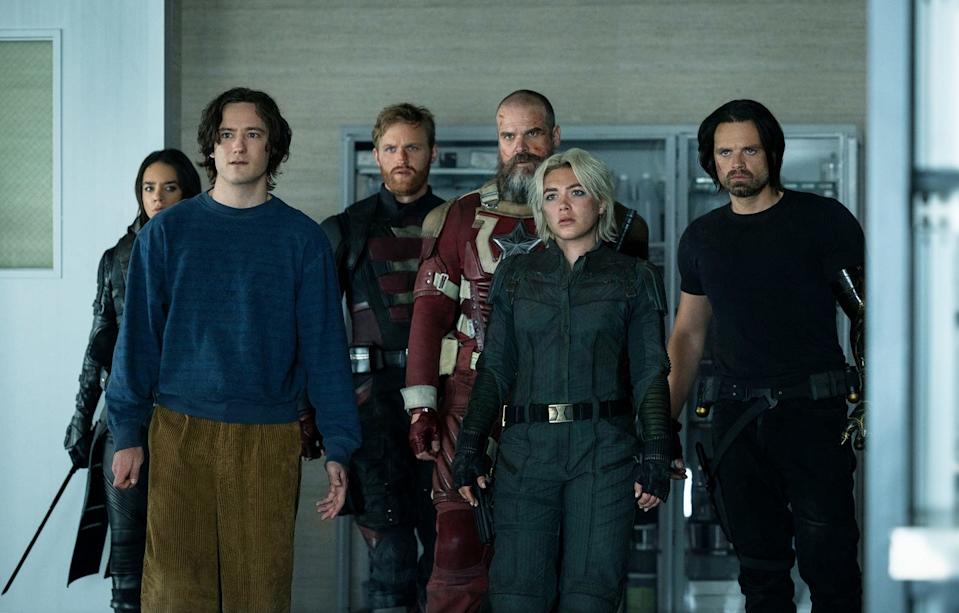
So, let’s get this straight: a group of charming, cool anti-heroes with varying degrees of “super-duper” abilities band together under the guidance of a tenebrous government organization. Well, you might think you’re watching the wretched Suicide Squad from 2016. Or it’s infinitely better (and bloodier) counterpart in 2021, directed under the new head of DC Studios, James Gunn.
Oh s***, this is Marvel! Okay, so let’s retrace our steps: a group of zany misfits band together to save the world. That’s so Guardians of the Galaxy familiar; where’s the talking tree and raccoon when you need them? But hang on, they’re not the cosmic protectors or the powerful group that once saved the city of NY in The Avengers, so you get the beloved name for this new group based on a childhood soccer team: Thunderbolts* (with an asterisk, per the title). I mean, they repeatedly tell you this new group is not the Avengers, so these are your glory days at hand, folks.
And perhaps that is the irony at play, because Marvel Studios, 36 films deep in the rabbit hole now, seems to be (desperately) backpaddling to their glory days to recharge their slate for the next blockbuster Avengers films that even lured Robert Downey Jr. back in the fold. For instance, recall how poorly Captain America: Brave New World rehashed the most scintillating ingredients from The Winter Soldier (which remains the best MCU sequel to date) or how Quantumania diluted the essence and fun of our beloved tiny hero by botching the character development in favor of spectacle. Thunderbolts* is indeed a worthwhile step up after a knack of mediocre storytelling and preposterous visuals in the past few years, even though the pomp and circumstance are all too familiar.
Director Jake Schreier attempts an interesting spin on a traumatic tale for self-worth and finding your place when deemed “scum” or “losers” in this world. And what better way than to have Yelena Belova (played by Florence Pugh) take the central stage in conveying a potent message. Pugh’s radiant performance is what keeps this film bound together, as she retains her roots with exceptional taste while simultaneously pondering her journey out of this wallowing pit of a violent past. Yes, Yelena may strut and snarl through her tasks, but her heart is missing from it, especially after the loss of her sister Natasha from the effects of Endgame. Where this team-up feature works is allowing the banter and subtle rivalries to take center stage, as each of the anti-heroes’ quiddities is what makes them fun and fresh to watch.
The plot follows CIA Director Valentina Allegra de Fontaine (Julia Louis-Dreyfus) being at the forefront of an impeachment trial due to several illegal operations, so she hires a group of rogue operatives that includes Yelena, discharged and disgraced former Captain America, John Walker (Wyatt Russell), the assassin Taskmaster (Olga Kurylenko), and the phaser “Ghost” (Hannah John-Kamen) under the pretense of a mission which ends up being a secret bunker intending to destroy evidence and these folks with them. But once the bullets stop firing and the knives get stowed away, out comes Bob (Lewis Pullman), a mysterious man with unparalleled powers, yet he was experimented on by Fontaine in a covert experiment. They escape, and while encountering the boisterous Red Guardian (David Harbour) and the former Winter Solder turned congressman, Bucky (Sebastian Stan), this group comes to realize of Fontaine’s dastardly tactics and set out to stop her while dealing with the dangerous duality of Bob. Why is that? Because, without much spoilers as it was featured heavily in the marketing, Bob’s dark side is known as the “Void,” turning everyone into shadows while becoming a dark, immortal supervillain.
As stated, Pugh is the emotional fulcrum of this work, but aside from Pullman’s good showcase of range, everyone else here is blandly tagging along as ridiculous background players. Harbour’s comic relief is almost more vexing than anything, and Dreyfus teeters around with no sense of urgency when her character is under the gun by corporate agencies and the U.S. government. Schreier understands his commitment to a worthwhile thematic, but sacrificing character, especially with a cornucopia of other MCU media available, feels bathetic as characters have been one of the rousing success stories of why we invest in the MCU. And the third act, a renowned trap in Marvel’s forte, gets a little lopsided when trying to weave in the themes and action.
Fortunately, there is a prevalent amount of good qualities woven into this film. It’s well-paced, with its structuring, and features some treats, particularly in the action choreography, which takes a more grounded approach. The dialogue is less pervasive with numerous quips that could be stated in contrast to many other Marvel works. Who would’ve thought that some backpedaling in this vast universe could do more good than harm?
So, Thunderbolts* earnestly carries its morose tonal attributes and pacing, buoyed by the backbone of a charming performance by Pugh. If this is the direction Marvel can lean towards, perhaps going back to their roots should be the answer. Let’s hope The Fantastic Four: First Steps proves that in July.


