

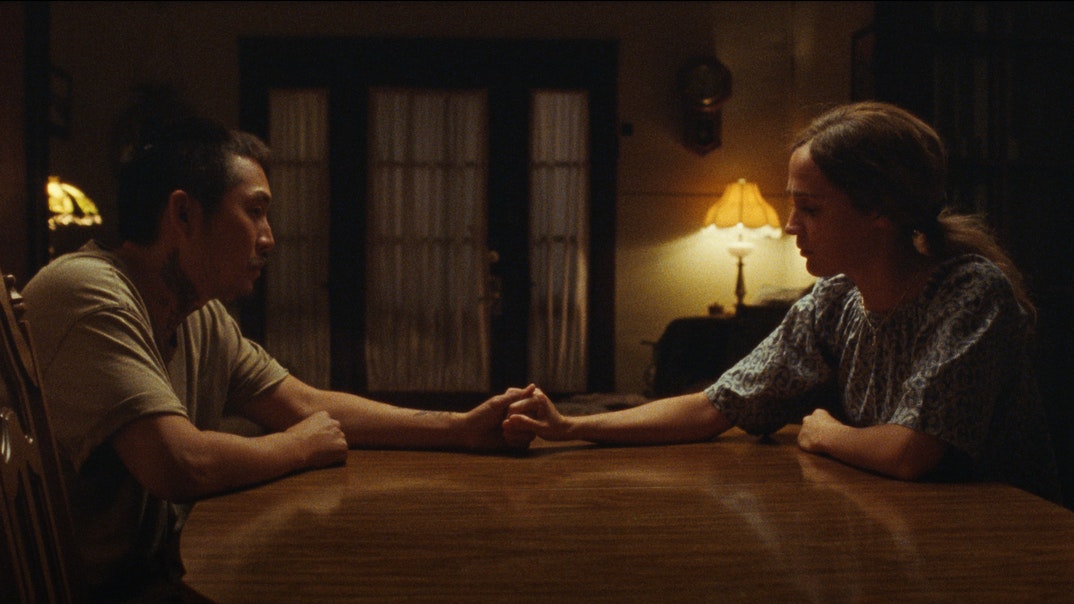
Joy Division’s “Love Will Tear Us Apart” rings so true in Justin Chon’s “Blue Bayou,” which he both starred in and directed. The film sees Antonio (Justin Chon), as an adopted Korean American that is in danger of being deported from America after a run-in with the cops, one of which is his wife’s ex-husband (Mark O’Brien).
Justin Chon brings this story of an adopted Korean American to life in a poignant way. That isn’t to say “Blue Bayou” isn’t flawed—it is certainly overdramatic—but like “Minari,” the film can highlight a story that is rarely talked about. As an adopted Korean American who also lived in the South, it was especially emotional seeing Antonio’s family being torn apart due to an event that was not even their fault. Antonio and his wife Kathy (Alicia Vikander) have an argument in the grocery store in front of their young child Jessie (Sydney Kowalske). That is when Kathy’s ex-husband and his partner Denny (Emory Cohen) confront them and beat up Antonio, which begins this tumultuous story. From there, Antonio and Kathy scramble to keep him in America, including finding a lawyer (played by Vondie Curtis-Hall). Being that Antonio does not have a lot of money, he begins turning to a darker part of his past to come up with the money that is needed.

Performances in “Blue Bayou” are outstanding across the board. Justin Chon has some really tender moments with Sydney Kowalske, and then some intense moments with Vikander. His directing choices also stood out, such as the grainy lens that covers the screen. It exudes the A24 aesthetic that make films feel more personal if that makes sense. Fans of the studio probably know what I am getting at. There is also a good amount of handheld camera movements in scenes where the stress is mounting. Vikander plays the everyday American girl extraordinarily well like Jennifer Jason Leigh can. Not mentioning Sydney Kowalske would be a crime, as her acting in the final moments is superb. The last five minutes of the film are emotionally draining, and her performance will bring a tear to your eye.
“Blue Bayou” is another great example of Korean stories being presented in America. It’s not on the level of “Parasite” or “Minari,” but it does present an important issue such as deportation, and the film is a very moving picture. The two bridges that Chon’s character constantly goes back to in “Blue Bayou” are a great representation of what this film is about: Are you willing to split your family into two boats, even if it is only temporary?


