

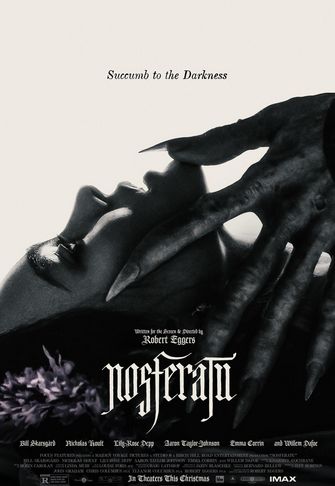
Garlic cloves and holy crosses may repel dark creatures of the night, but they always find a way to rise from the grave.
Nosferatu is the latest horror-inspired period piece from writer-director Robert Eggers and serves as his first foray into remakes. The original Nosferatu was made in 1922 as a black and white silent film conceived as an unlicensed adaptation of Bram Stoker’s Dracula novel. Nosferatu 2024 often feels closer to the source novel than the movie it shares its namesake with, such that Stoker receives a writing credit for the film alongside Henrik Galeen who wrote the original screenplay.
The film begins in 1838 Germany, when Thomas Hutter (Nicholas Hoult) is tasked with journeying out of the German town of Wisborg to Transylvania so he can present a potential client by the name of Count Orlok (Bill Skarsgård) with paperwork for a residence in Wisborg. Meanwhile, Thomas’ wife, Ellen Hutter, (Lily-Rose Depp) is angered with Thomas’ sudden departure and struggles with a dark secret involving Orlok throughout the film.
Depp gives a particularly phenomenal performance with her performance as Ellen. Her conflicted attitude forces her to switch between emotions suddenly and often. She can go from anger at her spouse, to despair regarding a mysterious illness, then love for her spouse and friends in a matter of moments. This role was originally intended for The Witch alumna Anya Taylor-Joy before scheduling conflicts caused her to drop out. It’s easy to see how her acting would inspire this role, but Depp does an inspired job in making the role her own.
Albin Eberhart von Franz (Willem Dafoe) is another notable portrayal. He is an eccentric professor with a penchant for the occult, who helps the Hutter family with their link to Orlok. Dafoe plays to a level of cheesy camp that fans of his will know and love, adding some much needed, but not forced, levity to a dark plot.
Orlok’s presence is constantly felt. Often only his shadow is visible on screen, seamlessly gliding through the room as an homage to the original film. When he is visible, the count is often obscured out of focus or just off frame of the camera. When unobscured, he looks horrific. A shambling, rotting corpse, freshly risen from the grave with a period accurate mustache and robes to match. His echoing, breathy voice switches between English, and Dacian, a dead language once spoken in Romania. He lacks the charming charisma that Gary Oldman possessed as Dracula in the 1992 film Bram Stoker’s Dracula, but instead appears as a monstrous manifestation of evil itself and is a haunting menace throughout the plot. Nosferatu means “the offensive one” or “the insufferable one,” and the count lives up to his name.
The landscape often looks like a cold, bleak painting, which highlights the effect Orlok has had on those who make his acquaintance. Dark nights, gloomy weather and the count’s foreboding gothic castle all support the ambiance of Nosferatu. The castle itself is not the lavish stronghold one may expect of nobility, but is instead a destitute ruin with no souls in sight. The lighting inspires a creeping sense of dread; Shadows cascade in long amorphous puddles washing many scenes in obscure darkness. During these times, the color will often drain from the screen and seamlessly shift to a black and white tone reminiscent of the original film. The mood isn’t always doom and gloom, however. Light from torches, lanterns and candles are often incandescently bright and warm, staving off the darkness the protagonists often find themselves surrounded in to evoke momentary feelings of security before the light bleeds away. These transitions between color and monochrome are masterfully integrated into scenes with no distractions or cuts.
As visually impressive as Nosferatu appears, pacing issues persist throughout the plot. It is often difficult to tell how much time has passed between scenes. It’s unclear how long Thomas spends entombed in Orlok’s castle, and this act feels like an afterthought compared to its prominence in the original. More time spent in Orlok’s castle in-line with the source material would have helped develop the stakes. These pacing issues persist into the third act, where the story wraps up with a confusing and abrupt conclusion that would have benefited from being fleshed out.
Despite these problems, this end is faithful to the source material and there is a lot here for vampire fans to sink their teeth into whether they’ve seen the original Nosferatu or not. Eggers has made another compelling chapter in his repertoire of historical horror that fans of fanged fiction and enthusiasts of his past work will surely enjoy as a new addition in the pantheon of vampiric media.


