

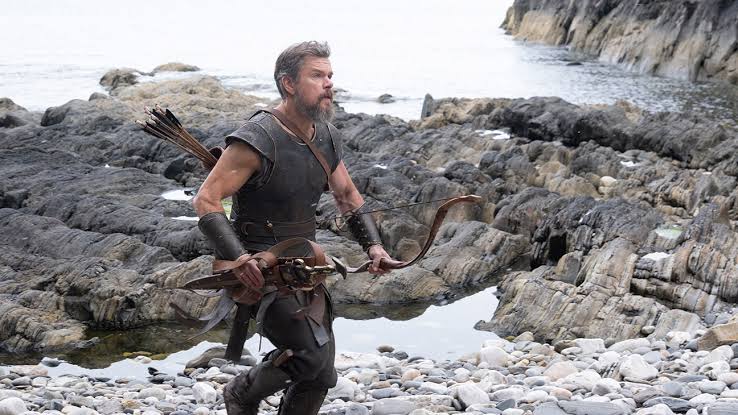
Well, it’s the Christopher Nolan dance, as per usual. Nonlinear plotting in a jumbled timeline before the pieces come together in awe-inspiring fashion. He’s tackled the bombs, the bravery, the heroes’ and villains’ tales, family, time, dreams, memories, magic, mystery, and a writer-turned-burglar in his vast array of scintillating works. This time it’s about mythmaking, based on the translations of Homer’s epic poem “Odyssey.”
And perhaps that is in alignment with Nolan, whose ability is to manifest tales with every thematic preoccupation and every ounce of jaw-dropping visuals and spectacle he can toss in. He doesn’t xertz through the aspects because he wants each moment to feel grander than the next. Nolan marshals the resources, cast, and crew to embellish a tale as old as time to convey a similar message to audiences: the man who journeys beyond the world can’t find his way back home.
So, for those who are not cognizant of this tale, Odysseus and his men journey to Troy and win the Trojan War, leaving behind his wife Penelope and son Telemachus on the land of Ithaca without a king in charge, sparking a mutiny from various suitors to claim the throne. After years of battling, Odysseus and his men spend many more years trying to get back home, sparking war and conflicts with various mythical creatures, armies, and the Gods themselves (notably Zeus and Poseidon). Bloodshed and destroyed ships galore, Odysseus survives as the last man landing on an island with Calypso, who drugs his mind with lotus flowers to forget what had happened. However, Odysseus is still haunted by Athena’s visions, and after regaining his memory, he finally builds a raft to race back home before the suitors attempt to kill his son and remarry his wife to take the throne.
Nolan prides himself, much as he did with Oppenheimer, on making this a survivor’s tale of trauma and guilt. Matt Damon, playing the Greek king, gives a phenomenal, terse performance as he recounts his memories while admitting to the failures of his men, who entrenched their side in darkness after they invaded the palace on a Trojan horse. It’s a paragon of sorts, keeping an underlying theme open: Odysseus may have been a good soldier, but he has made the wrong choices. And not to be overlooked, Anne Hathaway gives a formidable performance as Penelope, while Jon Bernthal brings swagger as Menelaus. Much of the cast otherwise comes with their A-game, with other standouts in Tom Holland, Lupita Nyong’o, Himesh Patel, and John Leguizamo.
And as per the standard, the music pulses across the screen thanks to Ludwig Göransson’s pounding score, and, coupled with the editing and cinematography, folks become enamored with the world and violence that happened a millennium ago. Nolan also does the justifiable by keeping the supernatural and the involvement of more gods tempered, allowing the audience to hold on to the sheer hope that Odysseus will return to reclaim his throne. The themes and action take center stage, validating Nolan’s obsession with crafting another homecoming on his end. One of the most enthralling scenes in the film is when the crew heads to Hades to witness the fallen soldiers emerge; it’s as if we’re reminded that none of this bloodshed is ever done for the greater good.
Granted, it’s another Nolan film that is quite lengthy and overstuffed yet defensible (for reenacting this tale), and some of the sound editing becomes evident when the music takes the front seat rather than the character and their dialogue.
But we’re at the point now where these nitpicks get lost in the fog of a dazzling epic that keeps you invested and satisfied. The Odyssey invites us into this ancient world with tactility and keeps us on the edge of our seats throughout.


