

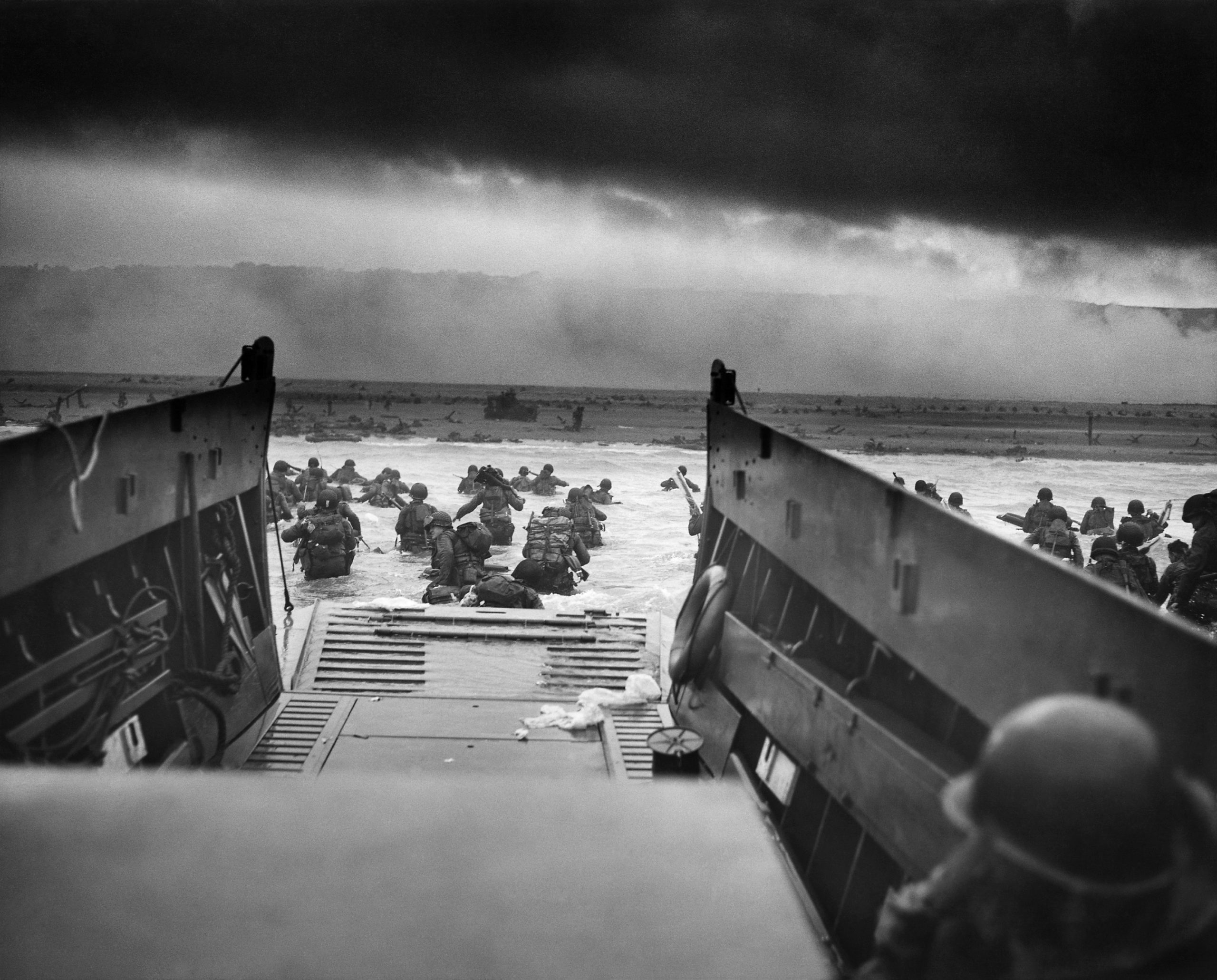
The past weekend saw the 75th anniversary of VJ (“Victory over Japan”) Day, officially ending World War II, the deadliest human conflict in history. Never before or since has there been an event that showcased the moral extremes of humanity on such a global and momentous scale; the war conjured up stories of hope fulfilled and selfless heroism while also plumbing the deepest depths of human depravity and capacity for evil. It brought out the best and the worst of a generation and, by extension, all of mankind. It is one of those rare events where history and action usurp the imagination, where real life becomes more unbelievable and more incredible than fiction. Indeed, some of these war-time stories inspired or formed the basis for many of the best fictional works of the twentieth century, including film. Thus, without further ado, here are the five films that most ably communicate at least one aspect of the complexities and intensities that characterized the most important, world-changing event of modern history.
5. The Ascent

A war film disguised as a religious parable, or vice versa? Neither: director Larisa Shepitko utilizes elements of both to create something unique, something of unparalleled psychological force that retains the devastation of betrayal from the biblical Judas narrative while also conveying the specific horrors of the Nazi regime. Much of the movie’s force derives from the personal, even vicarious, manner in which the film was presented. Shepitko constantly uses close-ups, lingering on the snow and bits of food caught in the soldiers’ beards. The sound design is almost entirely made up of breathing, grunting, and the sound of boots trudging through deep snow, thereby fully communicating the exhaustion of its subjects. There are also P.O.V. shots that expertly portray the characters’ inner states. The scene in the attic, where the gun protrudes through the door and aims right at the camera, is about as tension-filled as any Hitchcockian thriller. There is also that amazing sequence where the math teacher, who thinks he is about to die, looks around at the surrounding wilderness. The sudden rack focus suffuses the shot with a lyrical spirituality that communicates the detached serenity of impending death. Along with these elements, the film is quite original compared to the rest of Soviet canon. Throughout the story, Shepitko eschews the clichés of traditional Soviet war stories: the main action set-piece is relegated to the credit sequence with the titles superimposed over the screen and, in a particularly daring move, she subverted the role of the perfect soldier: indeed, it is the seemingly headstrong commander that cracks under interrogation while the sickly math teacher withstands torture and—in Christlike fashion—embodies altruistic patriotism. This notion is reinforced through the subtle changes in lighting: as time wears on in the prison cellar, the math teacher is gradually illuminated from overhead, creating a divine aura. In addition, the framing is impeccable. Along with the aforementioned close-ups and P.O.V. shots, also look at the first interrogation scene. Behind the math teacher, the wall is split up into black and white halves, representing his clear notions of good and evil and his ability to sidestep moral gray zones. The interrogator, however, is framed like a man at a normal civilian job: quaint office items decorate his desk while he is afforded a nice view of the town through the window. This foreshadows the revelation that this man, a cog in the Nazi machine, was once a Belorussian school teacher, a director of the children’s choir—in short, a normal everyday partaker of daily life. It is the manifestation of the term coined by Hannah Arendt, the “banality of evil”, which describes how bureaucratic everymen, inspired by professional promotion rather than ideology, were able to take part in the Nazi atrocities. This was a notion ubiquitous to World War II, and the film does extend beyond this specific tenet to capture the general existential angst of the event as a whole. The war destroyed any notion of universal morality or innate humanity, thereby creating a vacuum of chaos in which meaningless violence flourished. Such a portrait is concocted by the shots of the soldiers on the snow-covered landscapes: everything is rendered in such a blinding white that the sky seems to fuse with the ground to form a blank canvas, leaving the soldiers in a state of liminal limbo. It is the personification of those famous words by John Lennon: a bunch of nowhere men in nowhere land. What better describes the plight of those caught up in war, that state of constantly teetering on collapsing morals and flitting between life and death? Nothing, is the answer. This film, as a whole, is one of the ultimate, defining depictions of the most cataclysmic event in human history.
4. Patton

A multilayered and introspective biopic of one of America’s greatest and most controversial generals, George Patton. A common saying states that Patton was the only Allied general the Nazis truly feared. That may be true, but it leaves out that Patton was also probably the only Allied general that the Allies feared too. Although undoubtedly brilliant as a military tactician, Patton was notorious for his boisterous outspokenness and old-school beliefs on mental fortitude, often drawing the ire of other Allied military higher-ups and even some soldiers under his command. In what could have been a run-of-the-mill “man creates his own undoing” narrative, the film opts to explore deeper waters. Both a portrait of a man caught in a world of changing viewpoints (specifically with heightened sensitivity to mental trauma) and a rumination on the fleetingness of glory, the movie is just as complex as its central character. Featuring a career-defining turn by George C. Scott, an impeccable script penned by future master auteur Francis Coppola, and an iconic opening monologue, “Patton” remains a classic of American cinema.
3. The Cranes are Flying

An indelible portrayal of the tolls of war on the non-combatant citizenry. Here, we witness the initial innocence and joy of Soviet citizen life transform into a cold, holed-up existence in bomb shelters and temporary Siberian homes; an existence marred by emotional distance, knavery, cowardice, irreparable psychological damage, and the hampering impatience of waiting for loved ones to return. Shot with surprisingly modern fluidity and dynamic lighting and framing, the film is suffused with a lyrical quality that lends its heartbreaks a soulful despair and its emotional highs a weightless air that lets it soar above the cranes that open and end the film. The turning point of the film, when the scheming Mark finally “has” Veronika, is unforgettably powerful: the crescendo of the bombs falling, the strobe lights from the explosions, and the walk across the broken glass signify the destructiveness of what is transpiring, both intimately and to the country as a whole, in a haunting manner. And, of course, there is the pre-mortem dizzy spell, the last vision preceding death: the rotating trees flawlessly flashbacking to the roundabout trip up the stairs, which then culminates in the final daydream of matrimonial bliss. This is impressionism at its artistic peak: the interconnected stylistics of film capturing the inner individual, the soul, at its fundamental core.
2. Band of Brothers

Yes, this is technically a miniseries and not a film, but exceptions can always be made for the truly exceptional. This ten-part series centers on the real-life exploits of Easy Company of the 101st Airborne Division, documenting the fates of the soldiers from basic training in Georgia to the Normandy landings and to operations in Holland, Belgium, and finally, Germany. At the end of the ten hours, an inextinguishable bond exists between the characters, a bond that could only be formed through the communal experiences of suffering through fear and loss while awaiting, and eventually attaining, the triumph of selfless sacrifice and courageous perseverance. Here, the bond feels more real than almost any other cinematic depiction of brotherhood in war: part of that certainly has to do with the authenticity of the battle sequences, but the prime reason lies in the series’ acute characterization of its large ensemble. The writers do a great job establishing the idiosyncrasies and initial temperaments of each character in the beginning, and then spend every second of the remaining ten hours tracing the gradual evolution of the characters’ inner minds and their interpersonal interactions. Although the run-time clocks in at less than half of a day, by the end, it really does feel like one has spent the past two years with the company. In addition, because of the longer run-time, the series explores topics and storylines that other mainstream war movies rarely approach. The plight of non-combatants, for example, is a common thread, such as when the series shows shaming of Dutch women who slept with Nazis during Easy Company’s liberation of Eindhoven and featuring a subdued tragic romance in the episode “Bastogne.” Another essential episode, “Why We Fight”, questions and then ultimately reaffirms the justness and necessity of fighting the war as the unprepared American troops discover the horrors of a Nazi concentration camp. As such, this is one of the best (in this reviewer’s opinion, the best) projects with which Steven Spielberg has ever been associated; it even surpasses his World War II epic “Saving Private Ryan.” “Band of Brothers” is able to craft a deeply moving and affecting portrait of human connection without falling into the sentimental pitfalls that plagued parts of “Saving Private Ryan”; the reason here is that, unlike “Private Ryan”, “Band of Brothers” delineates the real experiences of actual people—the real-life soldiers even had a significant say in the production and writing of the series. The tether to reality thereby necessitates the accurate depiction of war, namely the primacy of chance and tragic accidents. Justice and redemption are scattershot and death can come in the most unheroic and unceremonious of forms. Luck and fortune rule the battlefield, a sentiment most clearly and profoundly expressed in the episode “The Breaking Point”, which focuses on The Battle of the Bulge. It even extends this notion beyond the battlefield and onto the whole world itself. During the reveal of the characters’ postwar fates, one of the key personages, having survived the greatest odds and some of the Western Front’s deadliest battles, returns home only to disappear at sea while sailing: a hero who managed to survive the most harrowing of war’s horrors, and yet there wasn’t even a body at his wake. Yet, fortunately, not all of the post-war revelations were as depressing; for some, it was quite the contrary. The most noticeable aspect of those final reveals, however, is how ordinary these men were, how after fighting the most evil tyranny in history and displaying incredible fortitude in the face of adversity, they simply went back home and worked their (mostly) blue-collar jobs with no further recompense. “Band of Brothers” lends serious credence to the label “Greatest Generation”; after seeing what these men went through, knowing that they were just normal young citizens who answered the call because they felt they had to for the sake of their country, and then coming face-to-face with their extraordinary modesty in the interviews with the real-life soldiers, one would be hard-pressed to disagree with that label. To cap this blurb, it feels fitting to quote the final lines of the series, spoken by the commander of the company. It perfectly encapsulates the selfless and humble qualities of these ordinary men turned heroes: “I cherish the memories of a question my grandson asked me the other day, when he said, ‘Grandpa, were you a hero in the war?’ Grandpa said, ‘No…but I served in a company of heroes.’”
1. Come and See

An experience nigh impossible to put into words, for how can one truly describe the barbarism and depravity of the Nazi occupation of Belorussia; nay, with such apocalyptic happenings, the only possibility is to see—hence the biblical title is an allusion as well as an instruction. That being said, the technical bravado is worth mentioning. The cinematography—ranging from Glasha dancing in the rain framed by rainbows to flying bullets shining like falling stars as they cut through wheat fields—is even more hypnotic than “Apocalypse Now”, and the close-ups (which are not unlike Klimov’s wife Larisa Shepitko’s close-ups in “The Ascent”) and sound design—which initially replicates the main character’s hearing problems after a Luftwaffe bombing raid before gradually morphing into a nightmarish cacophony of gunfire, disembodied screams, tinnitus ringing, and harsh, guttural German commands—combine to depict psychological degradation and trauma from a harrowingly interior point of view. No recounting can do it justice: this is quite possibly the greatest war film ever made, but it needs to be seen to be believed


