

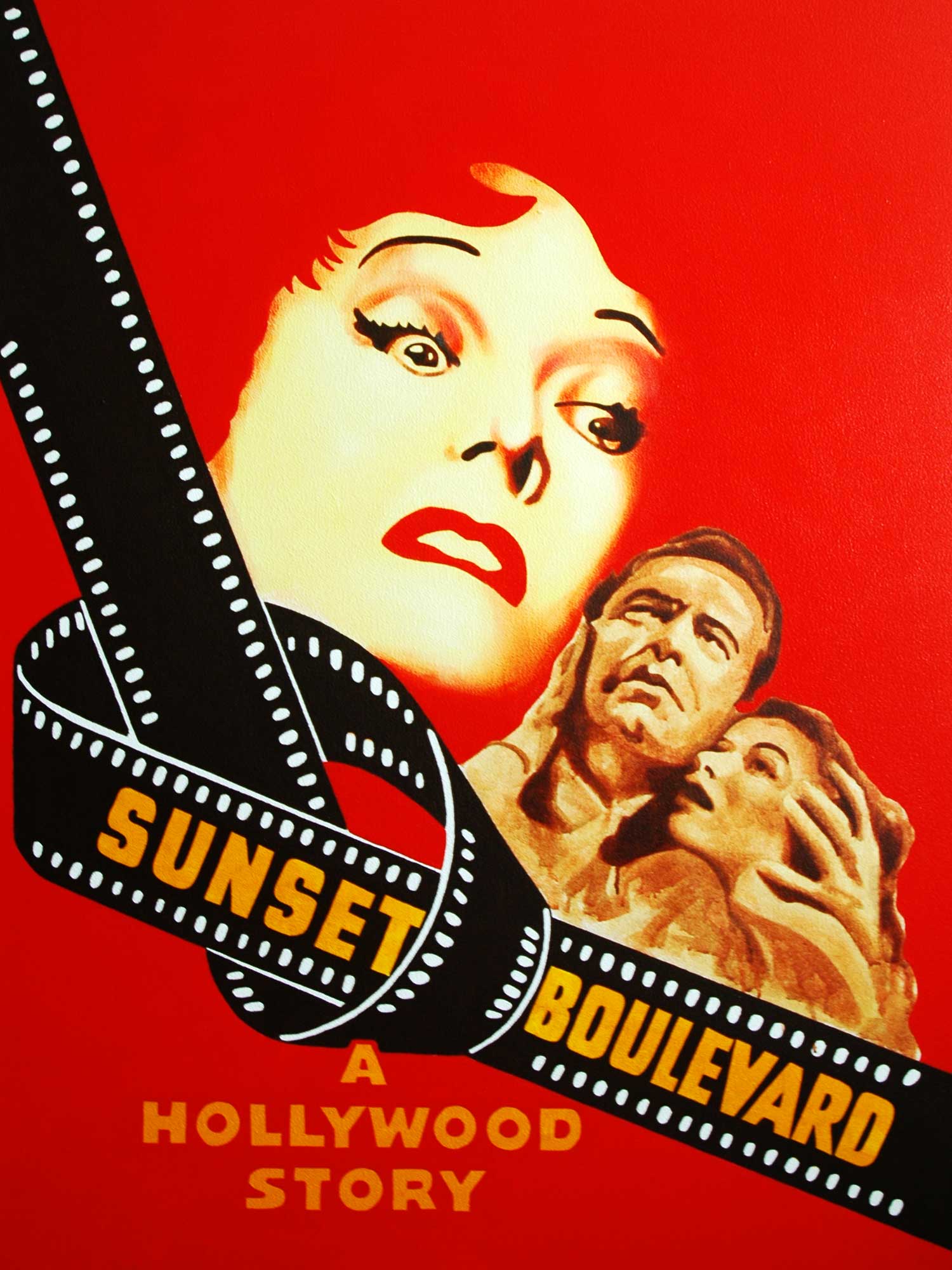
Seventy years ago today, Billy Wilder’s “Sunset Boulevard” was released in American theaters. Nominated for eleven Academy Awards upon release and included among the first batch of films selected for preservation by the National Film Registry, the film is still acclaimed by critics and film buffs alike and frequently cited as one of Billy Wilder’s best, an impressive feat considering his filmography includes classics such as “Some Like it Hot”, “Sabrina”, and “The Apartment.” Unlike those later comedies, however, “Sunset Boulevard” can be thought of as a mixture of two of Wilder’s darkest films, “Double Indemnity” and “Ace in the Hole”, while still having its own unique voice within Wilder’s oeuvre. A noir-tinged tragic romance (of the unrequited variety) that doubles as a self-reflexive insight into Hollywood and the poisonous specter of fame, “Sunset Boulevard” remains an undaunting portrait of the fallout of a former starlet who refused to accept the denouement of her stardom.
The set-up to the story is quite simple. A struggling screenwriter, behind on his rent and threatened with car repossession, seeks refuge in what he believes is an abandoned mansion, but is in actuality the home of former silent-movie star, Norma Desmond (played by former silent-movie star Gloria Swanson). She lets him board in a room above the garage and even adorns him with luxury items, given one condition: he must help her doctor and edit her adaptation of “Salome”, the vehicle that will be her great comeback. From there, the film accelerates into tragic and cynical territory, the power of which is bolstered by the one-two punch of its impeccably penned screenplay and the dynamo performance of Gloria Swanson.
The script won the Academy Award in 1950, and would probably win against most of the other winners had the film been released in any other year. Blending Wilder’s innate sense of black comedy with noir elements, the film has a unique feel to it unreplicated even by Wilder himself, a constant mixture of stifled giggling and genuine pity, at-times seemingly overly cynical and sarcastic (e.g., the narration refers to Norma and her fellow silent-movie compadres (who were played by real-life faded stars such as Buster Keaton) as ‘waxworks’) yet always retaining a sense of legitimate pathos, both in the tensions in the one-sided romance between the writer and Norma, and in the plight of Desmond’s butler, Max von Meyerling. Max is loosely autobiographical of his actor, Erich von Stroheim, a former major director of silent movies who was reduced to a minor character actor at the advent of sound. Having lost his repute, Max serves Norma by feeding into her delusions of grandeur, desperate to keep the woman he loves from acknowledging the painful truth of irrelevance.
The structure of the screenplay is also a marvel to behold. Beginning at the end, the movie’s opening details the fate of its main character before the story even begins, a distinctive methodology to inculcate a sense of doom throughout (not to mention, the way in which it was done has been imbued into pop-culture ever since, recently having had the privilege to be parodically copied by “Archer”). More subtly, the film also foreshadows the specific flavor of Norma’s predicament before she even shows herself by likening her house to the mansion of Miss Havisham, the lonely spinster in Dickens’ “Great Expectations.” Both women, living in abodes of broken dreams, are unable to escape the past and seek to recreate and reform their past experiences onto whoever crosses their paths. Finally, the script provides the trademark quotability factor that defines Wilder’s comedies, even providing its own ingenious and iconic ending line: “All right, Mr. DeMille, I’m ready for my close-up!” rivals the endings to “Some Like it Hot” (“Nobody’s perfect!”) and “The Apartment” (“Shut up and deal”) and may even surpass those due to the piteous preamble preceding it that confirms the finality of Norma’s madness.
Indeed, it is Norma’s descent into insanity that provides the true meat of the story, and it is rendered so palpable because of Gloria Swanson’s performance, the crown jewel of this film and of her career. Imbued with bursts of histrionics and exaggerated theatrical delivery and physical gestures, at first, the performance almost seems to undermine itself via self-parody. But it works, precisely because it fits in logically and thematically with the plight of the character. Acting in silent films was necessarily exaggerative and over-the-top since visuals were the only way to communicate emotions. Stuck in the past and unwilling to face the new reality of movies and Hollywood, it therefore makes sense for Norma to adhere to outdated screen-acting dogma, even subconsciously. The affected acting adds to the character’s pitiful state as a mere relic, an outsider to the industry that she had once dominated doomed to remain on the periphery as nothing but a fading memory; within this structure, the histrionics also serve the dual purpose of communicating her desperation at wanting to be re-accepted by the zeitgeist. As such, when her inevitable reckoning with reality comes, along with the dual-pronged rejection of romance by the young writer and adoration from the movie-going public, it is appropriately heart-rending.
“Sunset Boulevard” is therefore appropriate testament to Billy Wilder’s claim as one of the all-time greats and remains one of the best movies about movies to ever be made. Seventy years later, it is still an impeccably written and acted piece of cinema.


