

A bold, hypnotic feature that is every bit as dense and impressive as its predecessor.
Perhaps it takes a more engaging approach to these Dune features, as they are gigantic in terms of themes and ambitions. Director Denis Villeneuve comprehends the task at hand: encompassing a medium of transformative dreams and enveloping nightmares but breaking the boundaries of scope and narrative spectacle. In the essence of follow-ups, The Dark Knight told us you can dismantle the superhero genre with a wondrous complex tale on the effects of vigilantism and terrorism on society, and Terminator 2 wisely incorporated a scintillating dilemma about how humanity can correspond with artificial intelligence when technology becomes more expansive than imaginable someday. In the same vein, Dune: Part Two keeps its rhythm and stylistics like its predecessors but with a substantive approach toward religious power and colonialism.
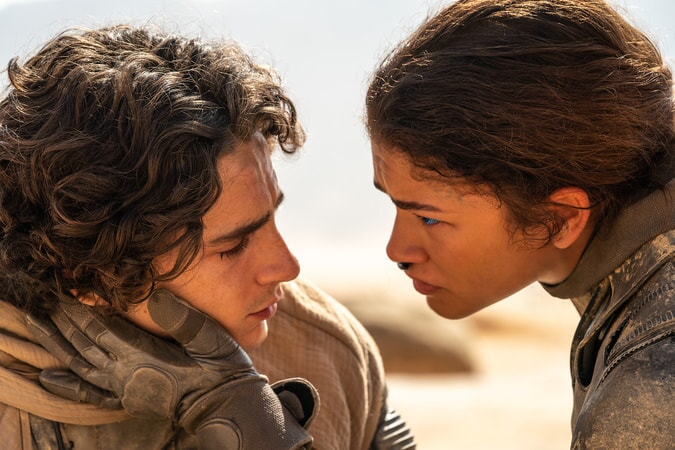
In terms of story, deposed aristocrat Paul Altreides (Timothee Chalamet) and his Bene Gesserit mother, Jessica (Rebecca Ferguson), are cast in the unpredictable wilderness of Arrakis. They work alongside the desert folk called the “Fremen” following the massacre of House Altreides in Part One. Accepted by one of the leaders, Stilgar (Javier Bardem), Paul learns the tactics of the desert folks while battling his visions on how the war will conclude between the Fremen and Harkonnens, led by Baron Harkonnen (Stellan Skarsgard) and his nephews, Glossu Rabban (Dave Bautista) and Feyd-Rautha (Austin Butler). Simultaneously, Paul also has an affair with Chani (Zendaya), another voice of reason for the freedom fighters. The primary matter at stake is control of the “spice,” which fuels interstellar space travel that is essential for the rulings of the galactic empire.

It does seem evident that it can become quickly frustrating to absorb an avalanche of information from the prophecies to gravity-defying space assassins to sandworms erupting throughout the colossal landscape of Arrakis. But Villeneuve doesn’t have time to hold your hand; he’s plunging right past our cynical beliefs to permeate the screen with magnificent, deft camerawork and stellar characterization. Chalamet brings a pulpy energy, transforming into the scarred revolutionary before our eyes; his character contemplates the battle between his heart and soul and whether he is the prophesized messiah that will lead the Fremen to victory on a firm-headed note. At this young age, the movie industry could bank on him for years, especially after some recent hits in the predecessor and Wonka. Zendaya keeps a steady balance of nerve and vulnerability, and Bardem is the amusing zealot blinded by his preaching of faith. Butler revels in some cartoonish evil that punctures the seriousness for the remainder of the film, while Ferguson keeps a small malevolence attached to her character.
Where the feature lacks some flow is the rushed nature of its structuring; some of the more breathtaking moments become more of an experiment than the apex of the act, and some characters, like Florence Pugh and Christopher Walken, become underutilized. It’s vexing to become attached when there is that notional knowledge of another part possibly coming in a few years to cap off the grandness of the story. Filmmakers should become cognizant that the deliberate undertaking of stretching out another chapter can leave other parts wallowing away in a clumsily capped-off approach. And unless Villeneuve got notes from Christopher Nolan’s audio crew, some of the audio and enhancements don’t punch the screen in that dazzling manner compared to the visuals.
However, yours indeed would be remiss not to state how paramount it would be to witness this feature in the multiplex. Villeneuve pours his heart into making Part Two a vast aspartame rush of a work buoyed by pure, engrossing spectacle and some worthwhile performances. Coupled with Hans Zimmer’s percussive score and compelling themes, this follow-up justifies its runtime and another example of excellence from Denis Villeneuve.


