

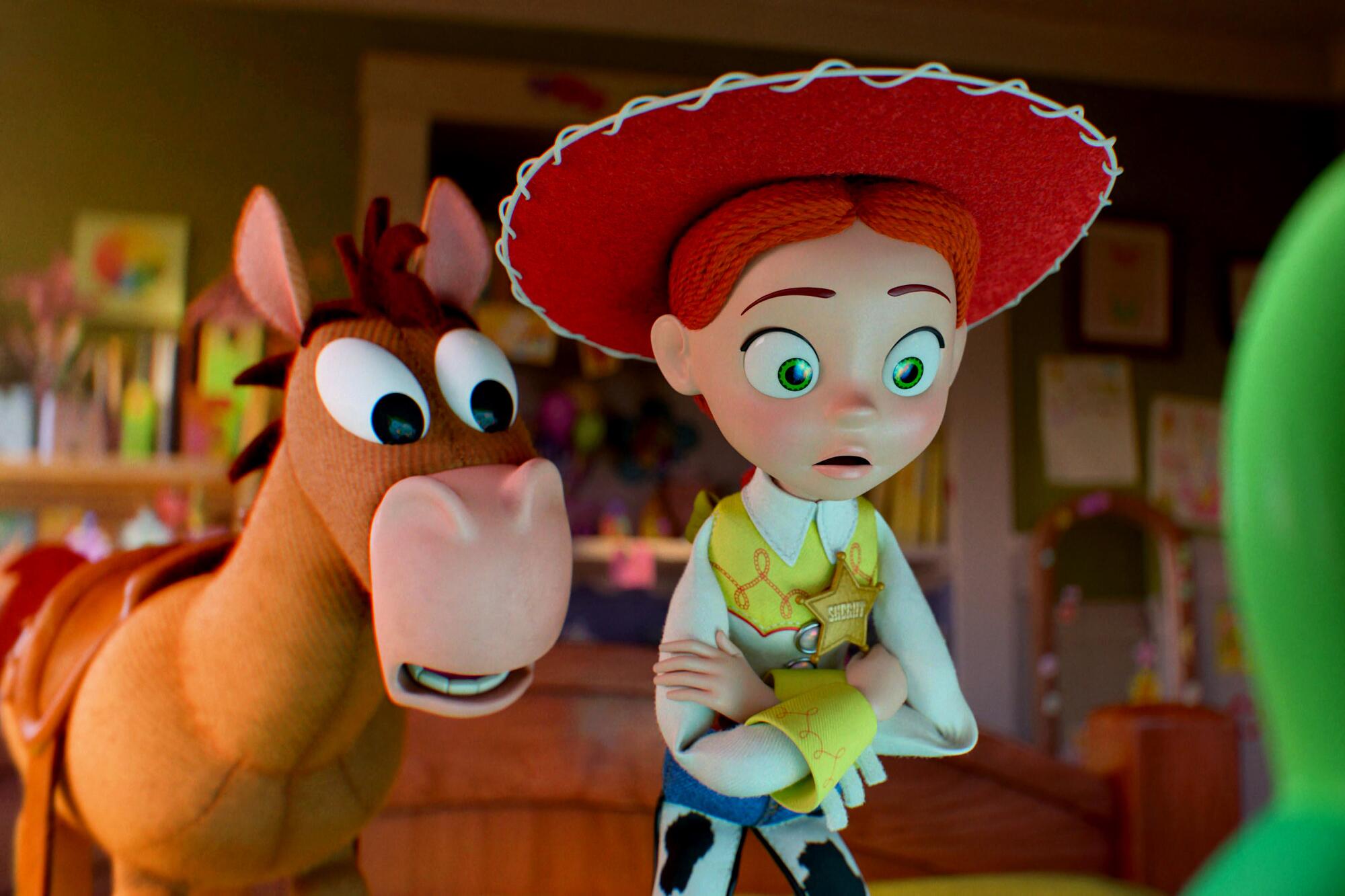
Ah, the most defining series in the Pixar canon returns with another (unnecessary) sequel featuring Woody, Buzz, Jessie, and friends. With that renowned bar of expectations, Toy Story 5 is an acceptable continuation of the three-plus decades-long series (man, does this writer feel old by those standards!) that offers another round for its toys while also offering an astute acknowledgment of the next greatest threat to their downfall: technology.
And to be perfectly fair, the latest tale does tackle this existential theme with great wit and wisdom. Pixar knows how to craft worthwhile stories that continue to persevere and touch our hearts in the most unimaginable ways possible. Toy Story 5, while spectacularly animated and blessed with great touches of humor and a strong voice cast, leaves a question (much like its 2019 predecessor): “Did we really need another one?”
Take, for instance, the beloved trilogy, with the apex of the third tale in 2010. Each story was centered on a universally relatable theme: growing up, leaving home, or letting go. The aspect of screentime peeping in is very much a modernly recognized issue, but the film jumps into the deep end without letting the themes settle this time around. It’s an unorthodox position, and for the first half of the film, it becomes frenetically chaotic. Fortunately, things settle in the second half, redeeming its stance and existence.
Anyway, let’s get to the plot: Young Bonnie (voiced by Scarlett Spears) still engages with the crew since Andy had relinquished them on her doorstep at the end of Toy Story 3, with Jessie (Joan Cusack), Buzz Lightyear (Tim Allen), and all the other characters that have been around. But Bonnie is still highly timid around the other kids and seems to have a knack for not making friends to socialize with, as the toys grow fearsome with the revelation that technology is taking over the other kids’ interests. Bonnie’s parents bring home Lilypad (Greta Lee), a hypnotic tablet that lets Bonnie chat with girls in one of her classes.
Jessie, not wanting to fall into the same trap as she did with her previous owner, Emily, tries to help but ends up at Emily’s former house, now home to a new family and a young girl named Blaze (Mykal-Michelle Harris), who also shares an affinity for toys and imagination. Jessie works to bring Blaze and Bonnie together as friends, while the other toys and a returning Woody (Tom Hanks), who has been in self-exile since the last film, have to deal with Lilypad’s antics. Jessie also stumbles across some neglected battery-powered devices, including a toilet-training game (Conan O’Brien), a camera (Shelby Rabara), and a hippo-shaped GPS (Craig Robinson), which help her with her goal.
It’s a relatively cohesive work, balancing the toys’ emotional dilemma of being forgotten in favor of technology while also highlighting how technology itself can cause irreparable harm and destruction to kids (and families). The 50 upgraded Buzz Lightyears running around to find “Starship Command” is relatively fun and vibrant, and it’s good to see the main names back together in the ensuing relationships and tension they’ve brought for decades.
However, one gripe of the film that suspiciously stands out is that the plot didn’t need Woody. Yeah, you heard it right. The beloved cowboy becomes an unnecessary tag man for the duration of the film, neither amplifying the story nor the characters’ troubles. It also concimitantly serves as a detriment to Buzz’s growth in trying to marry Jessie, which has been teased since the end of Toy Story 2. And another problem with the sheer number of new faces in this film, some characters get lost in the footnotes as we near the finish line. Keanu Reeves’ Duke Caboom, one of the best parts about Toy Story 4, gets only seconds to dazzle the screen once again. Bo Peep becomes a chauffeur. The Potato Heads barely get two lines in. The “you’ve said our lives; we’re eternally grateful” aliens don’t even get one line?
Despite being arguably the worst in the series, the film still retains the brilliance and grandeur of a Pixar production, with compelling themes to explore and touching moments that tug at our heartstrings (even if they’re not as potent as the predecessors). In the end, Pixar can still deliver a resonant and wonderful conclusion. But, when does the time come to say we’ve done all we could with Woody, Buzz, and friends on the floor of a kid’s bedroom?


